

Knee Pain After Running: 4 Common Causes and What to Do
This article was written with input from
Nicklas Falkesgaard Pedersen
Physiotherapist
Do your knees hurt after running?
You're in good company. The knee is the most common place for running injuries. Most knee pain in runners comes from overload, and it usually gets better when you adjust your training and strengthen the right muscles.
In this article, you'll learn:
- The 4 most common causes of knee pain after running
- When you should see a doctor
- What to do when your knee hurts
- How to prevent knee pain, with 4 exercises
4 common causes of knee pain after running
1. Runner's knee: pain around the kneecap
Runner's knee, or patellofemoral pain syndrome, is a dull ache around or behind the kneecap. It often gets worse on stairs, downhill, when squatting or after sitting for a long time with bent knees.
2. IT band syndrome: pain on the outside
Sharp pain on the outside of the knee that often starts at the same point in every run. Read our guide to IT band stretches.
3. Patellar tendinopathy: pain below the kneecap
Pain in the tendon just below the kneecap, often called jumper's knee. Hills, jumping and fast running usually make it worse.
4. Something else
Meniscus tears, ligament injuries and arthritis can also cause knee pain. These are often linked to swelling, locking or a feeling that the knee gives way.
When to see a doctor
- Your knee is swollen, red or warm.
- It locks, catches or gives way.
- You can't put weight on the leg.
- The pain started after a fall or a twist.
- It hurts at rest or wakes you up at night.
See a physiotherapist if the pain doesn't improve after 2-3 weeks of reduced training.
What to do when your knee hurts
- Reduce the load: Run shorter, slower and flatter, and skip downhill running for a while.
- Let the pain guide you: A mild ache that settles by the next morning is usually okay. Sharp pain, or pain that's worse the next day, means you should back off.
- Keep moving: Cycling, swimming and strength training keep your fitness up without the impact.
Why weak hips often show up in the knee
Many knee problems in runners start further up. When your hip muscles can't keep your pelvis stable, your knee drifts inward every time you land.
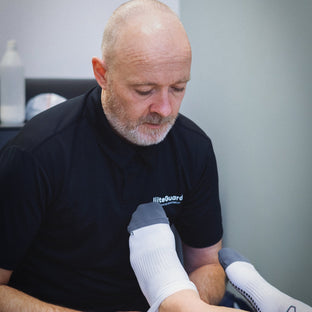
"When a joint can't hold its natural position, the joints around it have to compensate. If your hip isn't stable, it affects how your knee works," says physiotherapist Nicklas Falkesgaard Pedersen, co-founder of liiteGuard.
How to prevent knee pain from running
- Build up gradually: Increase your mileage slowly and add only one new thing at a time.
- Raise your cadence a little: In a lab study of 45 runners, a 5-10% higher cadence reduced the load on the knees. Read our guide to running cadence.
- Strengthen your hips and thighs: Strong muscles take load off the knee joint.
- Check your shoes: Worn-out shoes change how you land.
4 exercises for runner's knee
- Step-down: Stand on a step on one leg and slowly lower the other heel toward the floor, keeping your knee in line with your foot. 3 sets of 10 on each leg.
- Wall sit: Lean against a wall with your knees bent at about 60 degrees. Hold for 30-45 seconds, 3-5 times.
- Side-lying leg raise: Lift your top leg to about 45 degrees and lower it slowly. 3 sets of 12-15 on each side.
- Glute bridge: Lie on your back with your knees bent and lift your hips until your body forms a straight line. 3 sets of 12.
Find more exercises in our guides to gluteus medius exercises and strength training for runners.
Frequently asked questions about knee pain after running
Is running bad for your knees?
No. In a review of 17 studies, recreational runners actually had less knee and hip osteoarthritis than people who didn't run, so running may even be good for your joints.
Can you run with runner's knee?
Often, yes, if you reduce the load and keep the pain low. Choose flat routes, run shorter and add strength training.
How long does knee pain from running take to go away?
Mild overload often settles within a few weeks. Pain that has built up over a long time can take a few months, so start adjusting your training early.