


IT Band Syndrome in Runners: Symptoms, Causes and Treatment
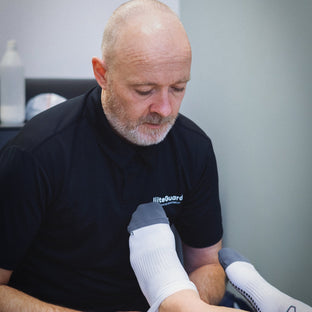
This article was written with input from
Nicklas Falkesgaard Pedersen
Physiotherapist
Sharp pain on the outside of your knee that stops you mid-run?
IT band syndrome is one of the most common causes of knee pain in runners. The good news is that it usually responds well to the right mix of rest from aggravating runs, strength training and a gradual return.
In this article, you'll learn:
- What IT band syndrome is
- The typical symptoms
- What causes it in runners
- How to get back to running
What is IT band syndrome?
The iliotibial band, or IT band, is a thick band of tissue running down the outside of your thigh from the hip to just below the knee. IT band syndrome (ITBS) is an overuse problem where the area on the outside of the knee gets irritated from repeated load.
Two hip muscles, the gluteus maximus and the tensor fasciae latae, attach to the IT band. That's why the hips play such a big role, both in why the problem appears and in how you get rid of it.
Symptoms of IT band syndrome
- Pain on the outer side of the knee, which can move up along the thigh.
- Pain that builds gradually and often starts at the same point in every run.
- Pain that can become sharp enough to make you stop.
- Pain that's worse running downhill or down stairs.
- Tenderness on the outside of the knee when you press on it.
When to see a doctor or physiotherapist
Get your knee checked if it swells, locks, gives way or hurts at rest, or if the pain started after a fall or a twist. These are not typical signs of IT band syndrome.
What causes IT band syndrome?
- Too much, too soon: A sudden jump in mileage, a lot of downhill running or long runs on a sloped road.
- Weak hips and core: When your hip muscles can't keep your pelvis stable, your knee drifts inward and the outside of the knee takes more strain.
- Stiffness and restrictions: Limited movement around the lower back, pelvis and hips can change how the leg is loaded.
- Shoes and foot position: Worn-out shoes or the way your foot lands can affect the whole leg.
"Personally, I always look at where in the body there may be restrictions and weaknesses, and then make sure to remove them. Restrictions need treatment, and weaknesses need training," says physiotherapist Nicklas Falkesgaard Pedersen, co-founder of liiteGuard.
How to treat IT band syndrome
- Reduce the load. Cut back on the runs that trigger the pain, especially downhill running. Cycling and swimming keep your fitness up.
- Strengthen your hips and core. This is the most important part. Start with our gluteus medius exercises.
- Stretch and foam roll. It can ease tension in the muscles around your hip. See our IT band stretches.
- Work on mobility. A few easy mobility exercises for your lower back, pelvis and hips before every run help your body move freely.
- Get help if it lingers. A physiotherapist can find the restrictions and weaknesses behind your pain and give you a plan.
How to return to running
- Start with short, flat runs that end before the pain begins.
- Run every other day at first, so your knee can settle between runs.
- Increase the distance gradually as long as the pain stays away.
- Take slightly quicker steps. A small increase in cadence reduces the load on your knees and hips.
- Avoid long downhill stretches until you're back to normal.
Pain around or behind the kneecap instead? Read our guide to runner's knee, or see all common causes in knee pain after running.
Frequently asked questions about IT band syndrome
Will IT band pain go away?
Yes, in most cases. With less load and the right strength work, many runners are back to normal within a few weeks to a few months.
Can you walk with IT band syndrome?
Usually, yes. Walking is often pain-free and a good way to stay active. Stop if it causes sharp pain.
What is the best sleeping position for a sore IT band?
Many people find it comfortable to sleep on the opposite side with a pillow between their knees, so the sore side isn't pressed or pulled.