


Marathon Fueling: How to Carb Load and Fuel During Your Race
This article was written with input from
Nikolaj Bonde
Running coach and elite runner
Afraid of hitting the wall?
Your body can only store enough carbohydrates for about 90-120 minutes of hard running. In a marathon, fueling is what keeps you moving at the end. Here's how to carb load, what to eat on race morning and how much to take in during the race.
In this article, you'll learn:
- How to carb load before a marathon
- What to eat on race morning
- How many carbohydrates and gels you need per hour
- How to train your stomach for race day
What does it mean to hit the wall?
Hitting the wall is when your glycogen stores run low and your body can't keep up the pace. Your legs feel heavy, your pace drops, and every step feels hard. It often happens around mile 18-21 (30-34 km).
Good fueling, before and during the race, helps you avoid it.
Carb loading: the days before the race
Start carb loading 36-48 hours before the race. The sports nutrition position statement from the American College of Sports Medicine recommends about 10-12 grams of carbohydrates per kilogram of body weight per day in this period. For a runner weighing 70 kg (154 lb), that's 700-840 grams a day.
- Shift, don't stuff: Eat a bigger share of carbs, not just more food overall.
- Cut back on fiber and fat: They fill you up and can upset your stomach.
- Choose simple sources: White rice, pasta, bread, potatoes, bagels and juice work well.
- Expect to weigh a little more: Your body stores water with the glycogen, so 1-2 kg (2-4 lb) extra is normal.
Race morning breakfast
Eat 2-4 hours before the start, and stick to something you've eaten before your long runs. Good options are a white bagel or toast with jam, oatmeal with banana or rice with a little honey.
Aim for about 1-4 grams of carbohydrates per kilogram of body weight. Start at the lower end if you have a sensitive stomach. More ideas in our guide to what to eat before a run.
How many carbs do you need during a marathon?
The same guidelines recommend 30-60 grams of carbohydrates per hour, and up to 90 grams per hour in races longer than 2.5 hours if you use products that combine glucose and fructose. Most gels contain about 20-25 grams, so that means roughly 2-4 gels an hour.
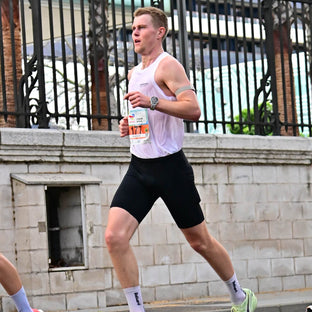
Running coach Nikolaj Bonde leaves nothing to chance in his own marathons. He takes his first gel after 20 minutes, then one every 18-20 minutes, and aims for 70-90 grams of carbohydrates per hour.
"I've underestimated energy before. I won't do that again," says Nikolaj Bonde.
Train your stomach
Your gut can be trained just like your legs. Practice your race fueling on your long runs, using the same gels, the same drinks and the same timing.
On race day, don't try anything new. Use only what you've tested in training.
What about fluids?
Drink to thirst, and take small sips at the aid stations. Drinking far more than you need can be dangerous, because it dilutes the sodium in your blood. On hot days, choose a sports drink with electrolytes.
Where to carry your gels
You'll need somewhere to keep your gels that doesn't bounce. In his marathon setup, Nikolaj Bonde runs in GLU-TECH short tights, which have room for 7 gels. GLU-TECH SHORT TIGHTS have two pockets with a snug opening at the top that keeps your gels in place.

Prefer shorts? The inner tights in GLU-TECH RUNNING 2IN1 SHORTS have two side pockets for your phone and gels.

Find your goal pace in our marathon pace chart.
Frequently asked questions about marathon fueling
How many gels do you need for a marathon?
It depends on your finish time and how many carbs you aim for. At 2-3 gels an hour, a 4-hour runner needs about 8-12 gels, minus any carbs from sports drinks.
Do you need to carb load for a half marathon?
Usually not. A carb-rich dinner the night before and a good breakfast is enough for most runners. If you'll be running for more than 2 hours, a lighter version of carb loading the day before can help.
When should you take your first gel?
Early, before you feel you need it. Many runners take the first one after 20-45 minutes and then keep a steady rhythm.