


Hamstring Strain in Runners: Symptoms, Causes and Recovery
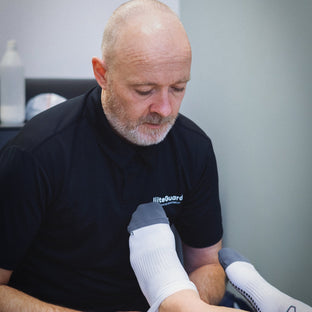
This article was written with input from
Nicklas Falkesgaard Pedersen
Physiotherapist
Felt a sudden stab in the back of your thigh during a fast run?
Then you may have strained your hamstring. It's one of the most common acute injuries in sports with sprinting, and runners get it too, especially during strides, intervals and fast finishes. Here's how it feels, how long it takes to heal and how to lower the risk of it happening again.
In this article, you'll learn:
- What a hamstring strain is and how it feels
- Why runners strain their hamstrings
- How to recover and how long it takes
- How to prevent hamstring strains
What is a hamstring strain?
Your hamstrings are three muscles at the back of your thigh. The biceps femoris sits on the outside, while the semitendinosus and semimembranosus sit on the inside. All three start at your sit bone and attach just below the knee.
They bend your knee and, together with your glutes, extend your hip. Most strains happen when the muscle is stretched while it's working hard, for example when your leg swings forward at speed just before it lands.
"In my experience, more than 90% of hamstring injuries come on suddenly. The pain hits right there and then, rather than building up gradually," says physiotherapist Nicklas Falkesgaard Pedersen, co-founder of liiteGuard.
What does a hamstring strain feel like?
- A sudden, sharp pain or stab in the back of the thigh, sometimes with a feeling of a pop.
- Pain when you try to speed up or take long strides.
- Tenderness and tightness in the muscle afterward.
- Pain when you stretch or tighten the muscle.
- Bruising a day or two later with more severe strains.
Strains range from a mild overstretch without torn fibers to a partial tear, where some of the muscle fibers rupture.
When to see a doctor
Get your leg checked quickly if you felt a clear pop, have large bruising, can't walk normally or have pain right at the sit bone. Numbness or tingling down the leg also needs a professional look.
Why do runners strain their hamstrings?
- Not warming up: Cold muscles aren't ready for fast running.
- Muscle imbalance: Very strong thighs compared with your hamstrings, or weak glutes that leave more of the work to the hamstrings.
- Restricted movement: Stiffness around the pelvis and lower back can make the hamstrings work from an awkward starting point.
- Lack of strength: Especially in the phase where the muscle works while it lengthens.
- Sudden speed work: Fast running after a long period of only easy miles, or when you're already tired.
How to recover from a hamstring strain
- Take a break from running for a few days. Walk if it's pain-free, and avoid anything that provokes sharp pain.
- Skip hard stretching at first. Pulling hard on a fresh strain can make it worse.
- Start gentle strength work. Begin with easy holds where you press your heel down into the floor, then build up to bridges and curls as the pain allows.
- Return to running gradually. Start with easy jogging once walking and light exercises are pain-free. Add strides and faster running last.
- See a physiotherapist. Getting the right help early can shorten your break considerably.
How long does a hamstring strain take to heal?
A mild strain often settles within 2-3 weeks. A partial tear can take from several weeks to a few months of rehab before you're back to full speed.
How to prevent hamstring strains
1. Strengthen your hamstrings
The Nordic hamstring curl is the best-documented exercise for preventing hamstring strains. A review of 15 studies with 8,459 athletes found that injury prevention programs including the exercise roughly halved the rate of hamstring injuries.
Kneel with your ankles held down, keep your body straight and lower yourself forward as slowly as you can.
"The exercise is hard, so start with only a few reps. If you've never done it before, I recommend 3 sets of 4 reps, and then build up gradually," says Nicklas Falkesgaard Pedersen.
Don't do it on the same day as a hard running session.
2. Warm up before fast running
Spend 10-15 minutes jogging and doing dynamic exercises before intervals or races. See our warm-up before running.
3. Keep your pelvis and lower back mobile
A few easy mobility exercises for your lower back and pelvis before each session help your hamstrings work from a good starting position.
4. Strengthen your glutes
Strong glutes share the work of extending your hip. Add our gluteus medius exercises and strength training for runners to your week.
5. Build up speed gradually
Ease into fast running with short strides before full intervals. Our 10 tips to run faster show how to add speed safely.
Frequently asked questions about hamstring strains
Is walking good for a hamstring injury?
Yes, as long as it doesn't hurt. Gentle walking keeps the muscle moving and supports healing.
Should you stretch a pulled hamstring?
Not hard in the first days. Light, pain-free movement is fine, but save real stretching until the muscle has started to heal.
Can you run with a hamstring strain?
Not at first. Wait until walking and strength exercises are pain-free, then start with short, easy runs and avoid sprinting until you're fully recovered.